


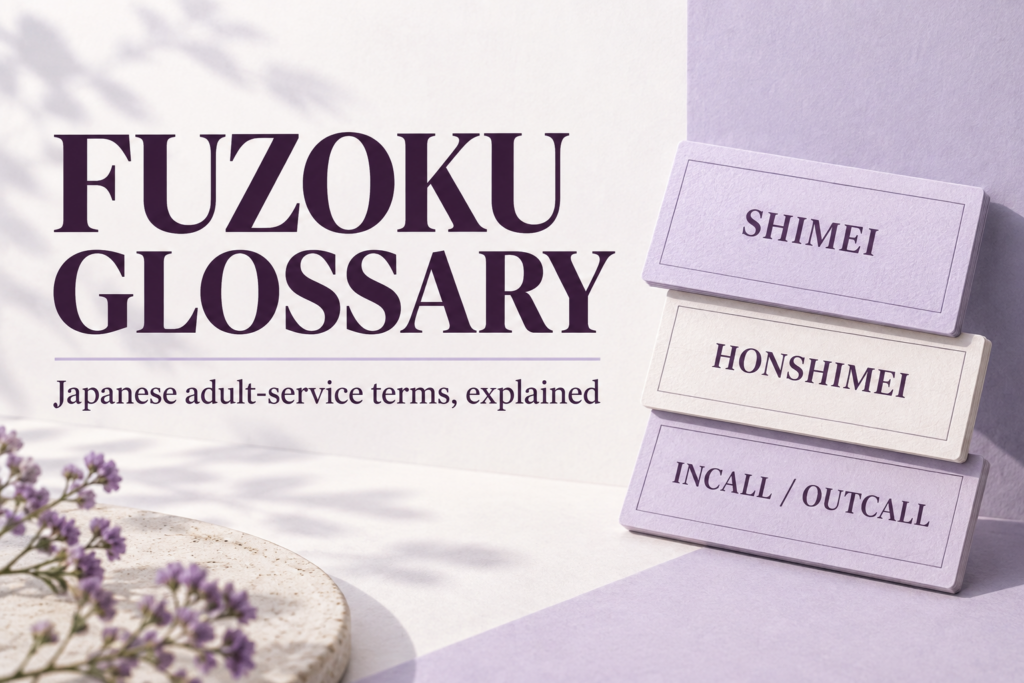
Fuzoku (風俗) is commonly used in discussions of adult nightlife as shorthand for Japan’s adult-services industry. It does not refer to a single service or type of business. The formal legal term fuzoku eigyo covers a broader range of regulated businesses, so its legal meaning differs from its everyday use.
This glossary focuses on Japanese terms that visitors may encounter when booking a deriheru (delivery health) service—an adult outcall service in which a companion travels to a hotel or residence. Terminology and fees vary by business, so use these definitions as a guide and confirm the final details with the business handling your booking.
Terms for choosing a companion
These words describe whether you are requesting a particular companion and how that choice is recorded. They do not, by themselves, explain what a booking includes.
| Term | Meaning | What to check |
|---|---|---|
| 指名 — shimei | Requesting a particular companion. | Check whether a separate fee applies for requesting a specific companion. |
| 本指名 — honshimei | Requesting a companion you have met before. | The term records a repeat request; it does not mean that the companion has a higher rank. |
| 写真指名 — shashin shimei パネル指名 — panel shimei |
Choosing a companion from her published photos or profile before meeting her. | Businesses may use different labels for this type of first-time request. |
| フリー — free | No particular companion is requested, so the business selects someone who is available. | “Free” means that no specific companion is requested. It does not mean that the booking is free of charge. |
| 指名料 — shimeiryo | A fee charged for requesting a particular companion. | Check whether it is included in the displayed price or added separately. |
| 即ヒメ — sokuhime | A companion who is currently available, or expected to become available soon, for a booking. | The term does not guarantee immediate arrival. Travel time and the destination still matter. |
How is honshimei different from photo nomination?
The difference is whether you have met the companion before. Choosing a companion from a profile before meeting her is photo nomination; requesting the same companion again after a previous booking is honshimei.
Terms for time, fees and additions
A displayed course price is not always the final total. Depending on the business and destination, separate charges may apply for requesting a companion, traveling to the location, or adding an option.
| Term | Meaning | What to check |
|---|---|---|
| コース — course | A booking plan for a stated length of time. | Check the duration, base price and what the plan includes. |
| 延長 — encho | An extension of the booked time. | An extension depends on availability and usually carries an additional charge. |
| オプション — option | An addition to the basic booking. | Check what the option covers and whether it is available with the selected companion. |
| 交通費 — kotsuhi | A transportation fee charged for travel to the destination. | The amount may depend on the area. |
| キャンセル料 — cancellation fee | A charge that may apply when a confirmed booking is cancelled or changed. | Ask when the cancellation policy begins to apply and what changes it covers. |
| 総額 — sogaku | The total amount after the applicable charges have been included. | Before confirming, compare the total with the course price and any companion-request, transportation, or option fees discussed during the booking process. |
Is the course price always the final price?
Not necessarily. A companion-request fee, transportation fee, option fee, or other stated charge may be added. Ask for the total amount before confirming the booking.
Terms used in profiles and photo diaries
Profiles contain both practical booking information and promotional content. A work name, photograph, or friendly diary post should not be treated as access to a companion’s private identity or personal life.
| Term | Meaning |
|---|---|
| 源氏名 — genjina | The name a companion uses for work. It is not necessarily her legal name. |
| 写メ日記 — shame nikki | A photo diary used to share updates with customers and present the companion’s work persona. |
| パネマジ — panemaji | Short for “panel magic,” a critical or subjective expression describing a noticeable difference between a profile photograph and the person’s appearance in real life. |
| 身バレ — mibare | Having someone’s work or private identity exposed outside the intended context. |

What does panemaji mean?
Panemaji, short for “panel magic,” describes a noticeable gap between a profile photograph and how someone appears in person. It describes the perceived difference, not one particular editing method.
What to confirm before booking
You do not need to memorise every Japanese term. The important point is to turn the vocabulary on the booking page into details that both sides understand.
- Companion: confirm the work name of the person you are requesting.
- Date and time: confirm the arrival time and length of the course.
- Destination: confirm that the hotel or area is within the business’s service range.
- Charges: ask for the total, including any nomination, transport or option fees.
- Payment: confirm the accepted payment method and when payment is due.
- Changes and cancellations: check the current policy before the booking is confirmed.
A term such as shimei or course tells you which part of the booking is being discussed. The business’s confirmation explains how that term applies to your specific request.
About the publisher
Club Focus Shibuya is a delivery-health business based in Shibuya. This glossary explains commonly used Japanese booking terms for English-speaking visitors. Terminology, fees, and booking conditions can vary between businesses.
This article provides general language and booking information. It does not define the terms of an individual booking or provide legal advice. Confirm current prices, availability, and rules directly with the business before booking.


