


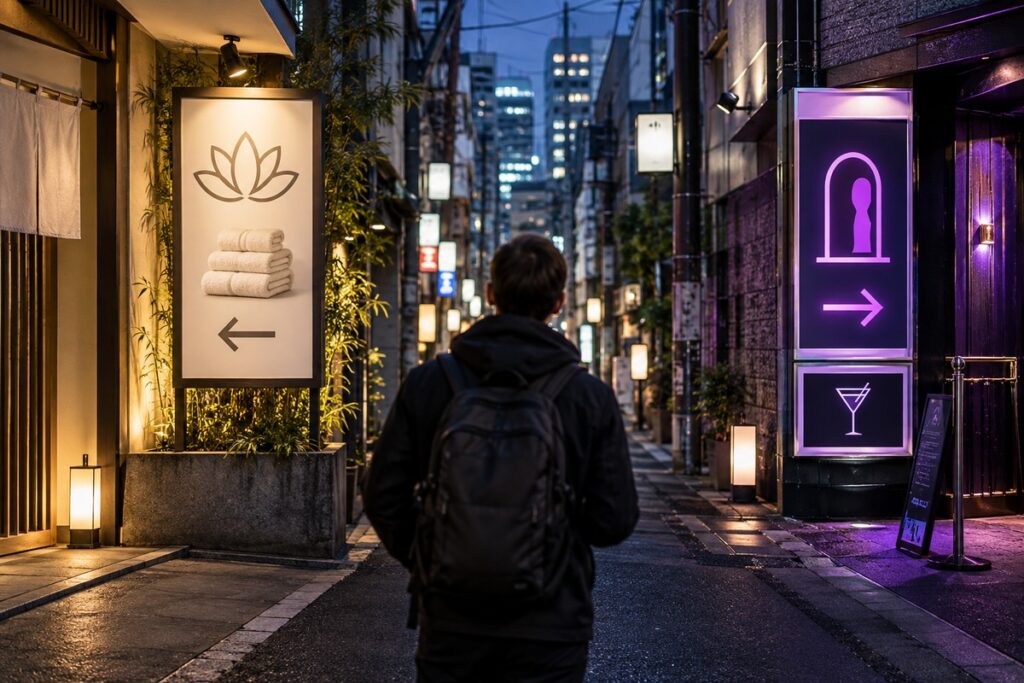
A “happy ending massage” is not the Japanese name for men’s esthe. In Japan, men’s esthe generally refers to relaxation or beauty services marketed to men, but the term itself is not a legal business category and does not by itself establish what a particular business offers. Sexual services are a separate question that depends on the provider’s actual services and operating model.
The useful distinction is not English versus Japanese. It is the service being offered, where it is provided, and the legal category that applies to the actual business.
What “happy ending” usually means in English
In English, “happy ending massage” is informal slang rather than the official name of a Japanese business category. It generally refers to sexual contact added to a massage, although the exact meaning can vary by country, website, and speaker. It should not be treated as a precise description of a particular service or legal category.
That definition helps explain the search term, but it has limits. Slang varies across countries, websites, and individual speakers. It is not a legal or regulatory category and cannot, by itself, establish what a particular business actually offers.
This is why a direct translation can be misleading. A visitor may search for “happy ending massage Japan” and assume that Japan has a corresponding business category. It does not. Japanese business classifications depend on the actual services provided and how the business operates, not on this English phrase.
Key point: “Happy ending massage” describes an informal idea in English. It is not a Japanese licence, registration or standard industry label.

Does “happy ending” always mean full service?
No. In typical English use, it refers to sexual contact added at the end of a massage, often a hand or oral act. It is not normally the same phrase as “full service,” although informal usage is never perfectly uniform.
Men’s esthe does not normally include an ending
In Japan, men’s esthe generally refers to relaxation or beauty services marketed to men. The term itself does not imply sexual services, and customers should not assume that manual or oral sexual acts, or intercourse, are included unless the provider explicitly states otherwise.
Depending on the provider, men’s esthe may include beauty treatments, oil treatments, or relaxation services. The word “men’s” identifies the intended customer group; it does not, by itself, indicate that the business provides adult services. If a provider states that sexual services are not offered, that statement should be taken at face value.
That distinction is not changed by businesses that use similar wording for different services. An adult-oriented business may use terms such as “esthe,” but that does not make sexual services part of ordinary men’s esthe. What matters is the actual service being offered, not the label alone.
The distinction matters for both customers and providers. Customers should not assume that an undisclosed sexual service is available, and relaxation providers should not be expected to negotiate services they have not offered. If the written rules say “no sexual service,” that should be understood as a clear service boundary.
Does men’s esthe in Japan include a happy ending?
Not ordinarily. Men’s esthe generally refers to relaxation or beauty services marketed to men, and the term itself does not imply that sexual services are included. Businesses that provide adult services should be distinguished by what they actually offer and how they operate, rather than by the word “esthe” alone.
The line is the service, not the label
Japanese business classifications depend on what services are actually provided and how the business operates, not simply on whether an advertisement uses words such as “massage,” “esthe,” or “relaxation.” For this topic, the key factors are the nature of the service, where it is provided, and the regulatory category that applies to the operation.
Guidance for ordinary relaxation services generally describes them as services intended to promote physical and mental relaxation rather than satisfy sexual interest. The practical distinction is important: hands-on contact does not, by itself, make a relaxation service an adult service.
Japan’s adult-entertainment framework uses more specific definitions based on how a business operates. One category covers certain adult services provided at a physical establishment, while another covers services dispatched to a customer’s location; the latter model is commonly associated with deriheru. The exact classification depends on the business model and the services actually provided, so an English nickname alone cannot determine the legal category.
Japan therefore has adult services that may involve contact an English speaker might loosely describe as a “happy ending,” but there is no licensed business category called “happy ending massage.” Ordinary relaxation services and deriheru also differ fundamentally: one is generally non-adult relaxation, while the other is an outcall adult-service model.
This is also why the question “Are happy ending massages legal in Japan?” does not have a simple yes-or-no answer. The phrase itself is informal and has no single legal classification. The relevant questions are what service is actually provided, where and how the business operates, which regulations apply, and whether the conduct complies with those rules.
| Layer | What it tells you | What it cannot prove |
|---|---|---|
| English label | How a writer or advertiser describes an idea | The Japanese legal category or a particular service menu |
| Published service rules | What the provider says is and is not offered | That every business using a similar name operates identically |
| Actual operation | The facts used to classify the business | Something a visitor can establish from a name alone |
Are happy ending massages legal in Japan?
The slang term has no single legal status. The applicable rules depend on the services actually provided, the business model, the location, and whether the operation complies with the relevant regulations. An individual business cannot be legally classified from the English phrase alone.
Why the sign and the actual category may differ
An advertisement describes how a business presents itself; it does not necessarily determine how the business is legally classified. If the services actually provided differ from the advertised description, authorities may assess the operation based on its actual conduct. The key point is that the underlying operation matters more than the label alone.
It would be a mistake to treat every men’s esthe shop as an adult business. Men’s esthe generally refers to non-adult relaxation or beauty services. A business that uses the label while providing adult services is an exception, not evidence that sexual services are normally part of men’s esthe.
A translated page may mix terms such as “massage,” “esthe,” “spa,” “adult massage,” and “fuzoku.” Look for a clear description of what the business offers, where the service takes place, whether it identifies itself as an adult business, and what it explicitly excludes. If the information is inconsistent, do not assume what is not stated.
Reviews and forum posts can help show how people use a phrase, but they do not establish a provider’s actual service menu or legal classification. The provider’s written rules and the way the business actually operates are more relevant than another customer’s wording.
A misleading label does not expand the normal meaning of men’s esthe. It shows why the actual operation matters more than the sign.
Can a shop call itself men’s esthe and still be treated as an adult business?
Potentially, if its actual operation falls within an adult-business category. Authorities look at what is provided and how the business operates. That does not mean ordinary men’s esthe is an adult service.
Massage, relaxation and adult service are separate questions
“Is it massage?” and “Is it an adult service?” are separate questions. Japan also distinguishes licensed anma, massage, and shiatsu from general relaxation services that do not claim to provide those regulated forms of treatment. Professional qualifications and adult-business classification are therefore separate issues.
That produces three categories people often collapse into one:
- Licensed treatment. Anma, massage, and shiatsu are regulated practices performed by qualified practitioners. Their provision and presentation are subject to rules governing these health professions.
- General relaxation. Oil treatments, body care, and similar services may be offered as relaxation rather than as licensed medical or therapeutic massage. The fact that a service involves physical touch does not, by itself, make it an adult service.
- Adult service. The regulatory question concerns the sexual services provided and the way the business operates. Simply calling the service “massage” does not make it an ordinary relaxation service.
These distinctions are not merely about terminology. Treating licensed treatment, general relaxation, and adult services as variations of the same thing can lead to misunderstandings about professional qualifications, service boundaries, and the applicable legal framework. It is clearer to identify what the provider offers, where and how the service is delivered, and which business category applies.
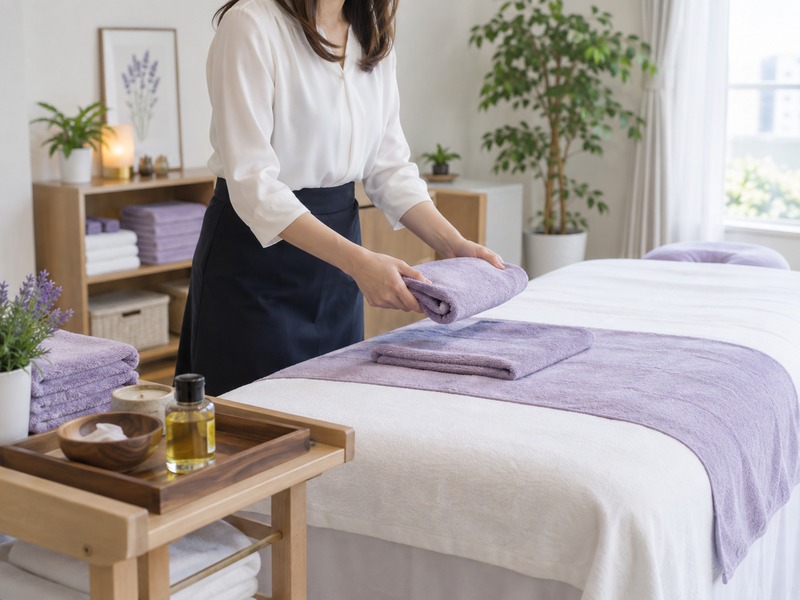
A clean spa-like room, an oil treatment or the word “massage” cannot answer all three questions. Presentation may describe the atmosphere, but qualifications and adult-business status depend on other facts.
How to read an offer without guessing from the label
The safest approach is to take the written service description at face value and not assume that unlisted sexual services are available. If a men’s esthe provider describes its services as relaxation and explicitly prohibits sexual services, the reasonable understanding is that sexual acts are not included.
For an adult business, focus on the services and operating model it actually describes rather than treating the word “massage” as a promise of a particular service. Store-based and outcall businesses operate under different frameworks, and their applicable rules may differ. If the page does not clearly explain what is being offered, the label alone is not enough to determine the service.
This approach also avoids making unfair assumptions about the people providing the service. Asking for an unlisted sexual act at a relaxation business does not reveal a hidden option; it crosses a boundary the provider has already stated. If the wording is unclear, ask what the published course includes rather than whether an unlisted sexual service can be negotiated.
- Is the phrase merely an informal English description, or is the provider identifying a specific Japanese business category?
- Does the provider describe relaxation, licensed treatment or an adult service?
- Is the service store-based or dispatched to another location?
- Do the written rules explicitly exclude sexual contact?
- Are you relying on the offer itself, or on an assumption attached to the word “massage”?
The phrase “happy ending” is not a Japanese business category. Men’s esthe normally excludes sexual services, while comparable sexual contact, when offered commercially, may fall within one of Japan’s adult-business categories. Keeping those starting points separate makes the rest of the terminology much easier to navigate.
About Club Focus Shibuya
Club Focus Shibuya operates a Shibuya-based adult outcall service commonly known as delivery health, or deriheru. This article explains Japanese nightlife terminology in clear international English, including the differences between informal search terms, non-adult relaxation services, and regulated adult-service businesses.
This article provides general information about terminology and business categories as of September 2026. It does not constitute legal advice or determine whether any individual business or act is lawful. Laws, classifications, and business information may change, so confirm current information with the relevant provider or authority.


